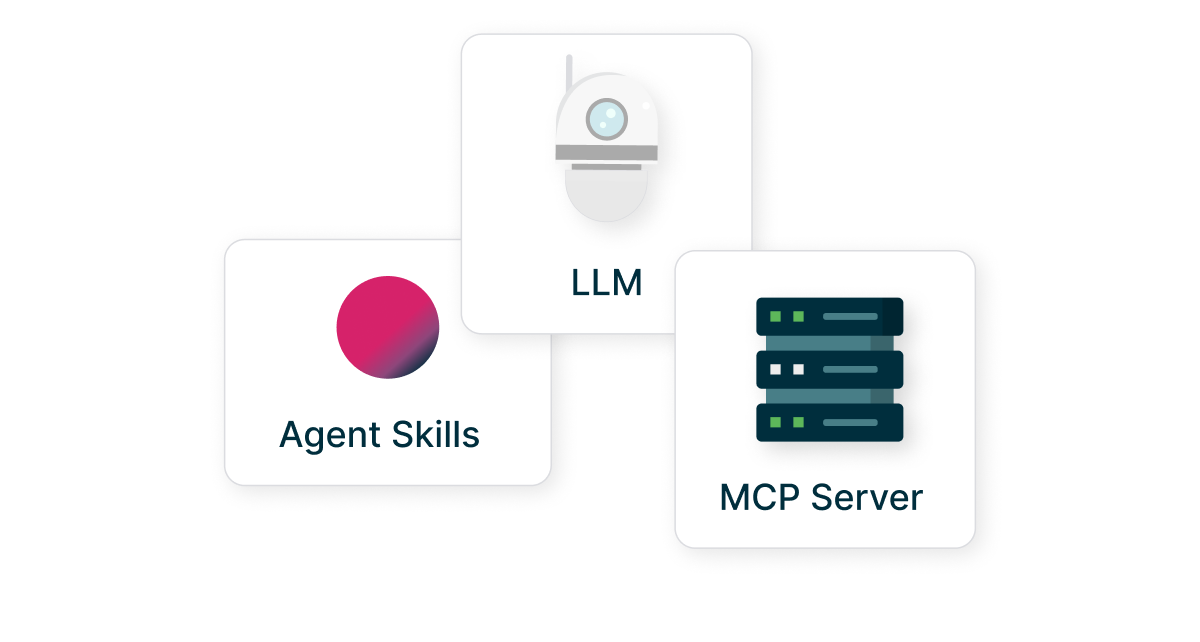
Updated: | Originally published: | By Hayley Brown
What are Agent Skills?
At a high level, skills do exactly what the name suggests, they give agents new capabilities. A skill may orchestrate existing tools, or introduce pseudo-tools via bundled scripts that the agent can explicitly invoke. They’re especially valuable for reusable prompts or repeatable behaviours that rely on local binaries. A “create pull request” skill, for example, can guide the agent to apply a consistent format, and push the result directly to GitHub for instance.
MCP and Agent Skills
Large language models (LLMs) are incredibly capable generalists, but true specialization in production systems doesn’t come from huge monolithic prompts. Instead, the real advancement lies in two complementary developments:
- Agent Skills are reusable, on-demand expert knowledge packs.
- MCP Servers (Model Context Protocol) are structured, safe interfaces that let models actually do work.
And together, they solve a core problem. They turn general LLMs into reliable specialists without stuffing prompts full of the same instructions over and over.
From Prompt Bloat to Dynamic Expertise
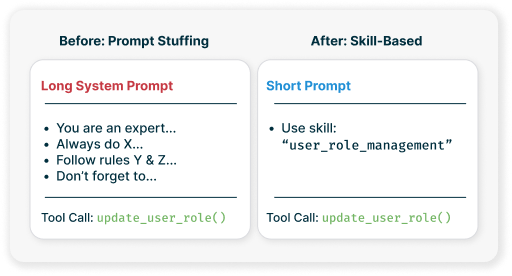
Traditionally, teams tried to make models behave like specialists by embedding long instructions into every prompt.
This approach has major drawbacks:
- Token waste as huge prompts are expensive
- Fragile behavior as small changes can break reasoning
- Poor reuse as similar logic gets rewritten again and again
Enter agent skills, lightweight, progressive knowledge packages that load only when needed.
What agent skills do:
- Encode workflows, best practices, scripts, and domain logic
- Load contextually based on task relevance
- Let the model work like an expert without prompt repetition
This is a paradigm shift as you’re capturing procedural knowledge, not just instructions.
What MCP Servers Bring to the Table
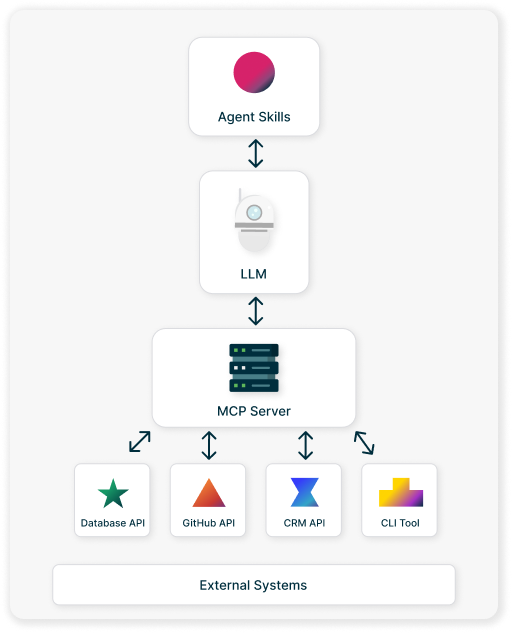
While skills teach how to operate, MCP servers open what the model can operate on. In other words the skills teach workflows and domain logic. MCP servers expose real tools such as APIs, databases, and custom logic over a protocol the model can call.
In other words, MCP servers are the plumbing that lets agents interact with external systems in a safe, structured, and extensible way. They are not just API wrappers, they define a protocol for discovery, tool invocation, and two-way integration.
Get the MCP Report
The MCP report consolidates public information from hundreds of SaaS companies to show how MCP is being adopted in practice. It maps adoption across verticals and company sizes, highlights common technical patterns, and provides a playbook that helps teams design MCP surfaces that are useful for AI assistants and safe for production use.
Why Skills Make MCP Development Better
Here’s where the real synergy happens as skills dramatically improve MCP server design and usage.
1. Embed Best Practices Automatically
LLMs still hallucinate when designing MCP schemas or tool interfaces. For instance, they’ll invent fields, misuse types, or create inconsistent patterns.
A well-crafted MCP skill, however:
- Encodes MCP best practices
- Includes tool design patterns
- Provides reusable prompt templates
The result is a production-ready MCP advice and fewer hallucinated mistakes.
2. Reduce Context and Token Consumption
Massive API surfaces like a 20,000-token MCP server spec are impractical to keep in memory.
But skills:
- Break domain logic into task-specific chunks
- Only load what’s needed when it’s needed
- Keep the context window manageable
The result reduced a giant API surface to a tiny active context window while agents executed nested workflows reliably.
3. Teach How to Use Tools (Not Just What They Are)
MCP servers provide capabilities, but models still need to know when and how to call them.
Skills can embed:
- Workflows that combine multiple tools
- Guardrails and SOPs for safe calls
- Task patterns that reduce tool misuse
In this sense, skills act like a runtime curriculum for the agent.
A Workflow That Scales
Bringing skills and MCP servers together looks like this:
- Define MCP tools – wrap APIs or services as protocol-compliant servers
- Create skills that teach usage – workflows, scripts, SOPs, error handling
- Agents discover tools dynamically – without prompt bloat
- Agents execute reliably – fewer hallucinations, consistent behavior
This combo turns a general LLM into a domain specialist that:
- Loads expertise on demand
- Interacts with real systems
- Follows best practices automatically
What This Means for AI Engineering
Agent skills and MCP servers are not competitors instead they’re co-drivers of reliable agentic AI development. While skills teach expert behavior, MCP servers provide real capabilities.
Together they enable:
- Faster prototyping of specialized AI tools
- Scalable, reusable workflows
- Cleaner separation between logic and interface
- Lower token usage and lower costs
So if you’re building next-generation AI systems, think less about stuffing prompts and more about architecting knowledge and tools that agents can learn and use dynamically.
Discover Cyclr’s MCP PaaS
The Agentic framework is the new standard, discover how to move beyond custom API wrappers and establish your SaaS as an AI-Ready Platform.
Why Wait? Accelerate your AI Roadmap in Days, not Quarters.
Discover how companies in your SaaS space are adapting to MCP
With increasing demand from users to be able to access their data directly through AI chat platforms, B2B SaaS companies are beginning to launch their own MCP strategies.
But how do you decide what functionality to make available via AI?
This is why we have researched over 800 B2B SaaS companies, ranging in size, vertical focus and growth stage to create a dataset of who is building what (and who is yet to implement a native MCP solution).
The tool below enables you to select a SaaS vertical category to see actual MCP use cases that have been implemented, also enabling you to see who has implemented it.