Updated: | Originally published: | By Hayley Brown
AI agents are quickly becoming a new class of user. For SaaS platforms, that raises a familiar question one they’ve already faced with integrations:
“How do we expose our product safely, at scale, and in a way customers can actually use?”
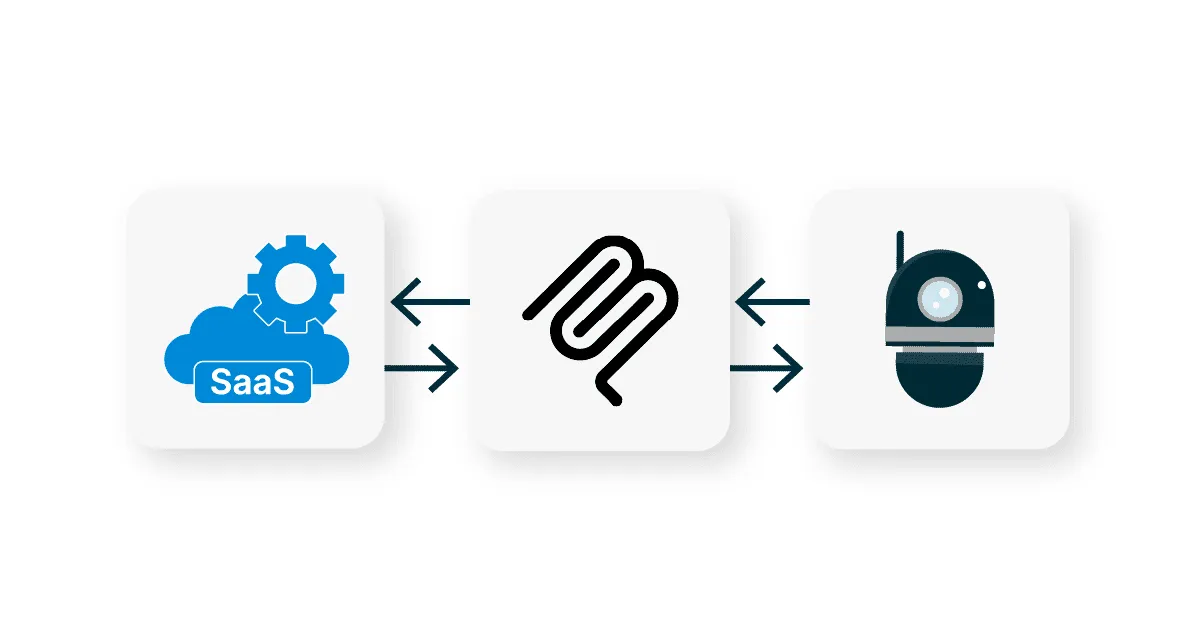
That’s where an MCP PaaS (Model Context Protocol Platform-as-a-Service) comes in. And increasingly, the most natural place for that MCP layer is inside an embedded iPaaS. Here’s why.
1. Because AI Agents Are Just the Next Integration Consumer
From an architectural perspective, AI agents aren’t radically new they’re another type of external consumer interacting with your platform.
Just like integrations, agents need:
- Defined actions
- Secure authentication
- Controlled access to customer data
- Reliability at scale
Embedded iPaaS platforms already solve these problems. An MCP PaaS built on an embedded iPaaS simply extends that same integration foundation to AI-native use cases.

2. Because APIs Alone Aren’t Enough for AI
APIs expose endpoints and AI agents need capabilities.
MCP adds:
- Descriptions of what actions do
- Context about objects and relationships
- Constraints and guardrails agents can reason about
An MCP PaaS layered onto an embedded iPaaS translates existing native connectors, workflows, and actions into agent-consumable tools. It does this without forcing teams to redesign their APIs.
3. Because Embedded iPaaS Already Understands Multi-Tenancy
One of the hardest parts of MCP isn’t the protocol, it’s tenant-aware execution.
SaaS platforms need:
- Per-customer credentials
- Per-tenant permissions
- Strict data isolation
- Custom configurations per account
Embedded iPaaS platforms like Cyclr are designed for exactly this. An MCP PaaS built on top inherits:
- Customer-level isolation
- Secure OAuth handling
- Scalable tenant provisioning
Without an embedded foundation, MCP becomes fragile or dangerous at scale.

4. Because AI Access Is an Integration Governance Problem
Giving agents access to your product isn’t just a developer concern, it’s a governance challenge.
Questions quickly arise:
- Which actions can agents trigger?
- What data can they read or write?
- How are actions audited?
- How do you roll back mistakes?
Embedded iPaaS platforms already provide:
- Centralized orchestration
- Logging and monitoring
- Controlled execution paths
An MCP PaaS extends those controls to AI agents, turning “agent access” into a managed integration surface, not a free-for-all.
5. Because Customers Expect AI to Work Across Their Tools
Customers don’t want AI features in isolation. They want AI that understands their ecosystem.
That’s where embedded iPaaS becomes critical:
- Integrations connect your platform to the wider SaaS landscape
- MCP makes those integrations agent-accessible
- Customers get AI that operates across systems, not silos
An MCP PaaS inside an embedded iPaaS lets your platform become a first-class participant in agent-driven workflows.
Get the MCP Report
The MCP report consolidates public information from hundreds of SaaS companies to show how MCP is being adopted in practice. It maps adoption across verticals and company sizes, highlights common technical patterns, and provides a playbook that helps teams design MCP surfaces that are useful for AI assistants and safe for production use.
6. Because MCP Is a New Monetization Surface
If integrations can be monetized, so can AI access.
With an embedded iPaaS-backed MCP PaaS, platforms can:
- Gate advanced agent actions behind paid tiers
- Offer AI-enabled integration packs
- Charge for usage, automation volume, or premium connectors
This mirrors how many SaaS companies already monetize integrations. Now monetization can be extended to AI-driven use cases.

7. Because Reuse Matters More Than Reinvention
Without a platform, MCP efforts often look like this:
- One team builds an MCP server
- Another manages credentials
- A third worries about scaling and security
Embedded iPaaS platforms already centralize:
- Connector logic
- Authentication
- Execution infrastructure
An MCP PaaS simply reuses that investment, accelerating time-to-market while reducing long-term technical debt.
8. Because Speed Is a Competitive Advantage
AI expectations are moving faster than traditional SaaS roadmaps.
An MCP PaaS built into an embedded iPaaS allows teams to:
- Launch agent support quickly
- Iterate without breaking customers
- Adapt as MCP standards evolve
That speed can be the difference between being AI-ready and being AI-replaced.
9. Because Embedded iPaaS Is Becoming the Control Plane for AI
As AI agents become more autonomous, platforms need a control plane, not just endpoints.
Embedded iPaaS already acts as that control plane for integrations. Adding MCP turns it into a control plane for:
- Human-driven automation
- System-driven workflows
- Agent-driven actions
That convergence is powerful and increasingly necessary.

The Bottom Line: MCP PaaS and Embedded iPaaS
You don’t adopt an MCP PaaS in isolation.
You adopt it because:
- AI agents are becoming real users
- Integration governance already matters
- Embedded iPaaS provides the missing foundation
For platforms already using, or considering an embedded iPaaS, MCP PaaS isn’t a leap.
It’s a natural next step.
Discover Cyclr’s MCP PaaS
The Agentic framework is the new standard, discover how to move beyond custom API wrappers and establish your SaaS as an AI-Ready Platform.
Why Wait? Accelerate your AI Roadmap in Days, not Quarters.
Discover how companies in your SaaS space are adapting to MCP
With increasing demand from users to be able to access their data directly through AI chat platforms, B2B SaaS companies are beginning to launch their own MCP strategies.
But how do you decide what functionality to make available via AI?
This is why we have researched over 800 B2B SaaS companies, ranging in size, vertical focus and growth stage to create a dataset of who is building what (and who is yet to implement a native MCP solution).
The tool below enables you to select a SaaS vertical category to see actual MCP use cases that have been implemented, also enabling you to see who has implemented it.


