Updated: | Originally published: | By Wilson Cheng
We continue our dive into Cyclr vs. n8n by comparing the two platforms in terms of Integration Delivery. For SaaS companies or consulting agencies, delivering multiple integrations to multiple customers often involves managing credentials, ensuring data security, and handling workflow deployment and maintenance.
This is where multi-tenant support, which serves as the foundation for delivering multiple integrations to multiple customers is crucial. After this, we explore the different embedded models offered by n8n and Cyclr.
Head over to why we also love n8n part 1 to read our comparison of the platforms connectivity, data orchestration and AI.
Cyclr, n8n and Integration Delivery
Starting with n8n, it does not initially include multi-tenant support. The simplest approach is to use a single instance with multiple projects managed through project member allocation and role-based access control (RBAC). This setup allows you to deploy different workflows and assign specific credentials to individual projects.
However, projects are not tenant-based, meaning there is limited monitoring, auditing, and usage tracking at the tenant level. While credential separation is not 100% enforced, this can still lead to potential security concerns. In addition, workflow maintenance can be challenging, as updates often need to be performed manually rather than through automation.
Furthermore, in the public cloud version (n8n Cloud), the Business plan only supports up to six shared projects. As a result, this may push users toward the Enterprise plan, a less suitable option for SMBs and startups. Although you can deploy multiple n8n instances in your private cloud, this approach requires significant engineering resources. As well as high maintenance overhead.
Cyclr and Multi-Tenancy
Unlike n8n, Cyclr offers built-in multi-tenancy, allowing you to manage multiple client accounts independently within a single platform. This is especially valuable when delivering similar integration workflows across clients, each requiring its own unique configuration.
For example, an IT service provider working with real estate development firms can create separate accounts for each client. They can customise data mappings to match individual systems, and adjust parts of a shared workflow to meet specific business requirements. Transforming a standard integration into a fully tailored solution.

With pre-built dashboards and reports, you can easily monitor usage metrics such as the number of connected users, errors per account, and workflow activity. Once an integration template is updated, Cyclr can automatically deploy those updates across multiple customer accounts. As a result, streamlining delivery and minimising manual effort.
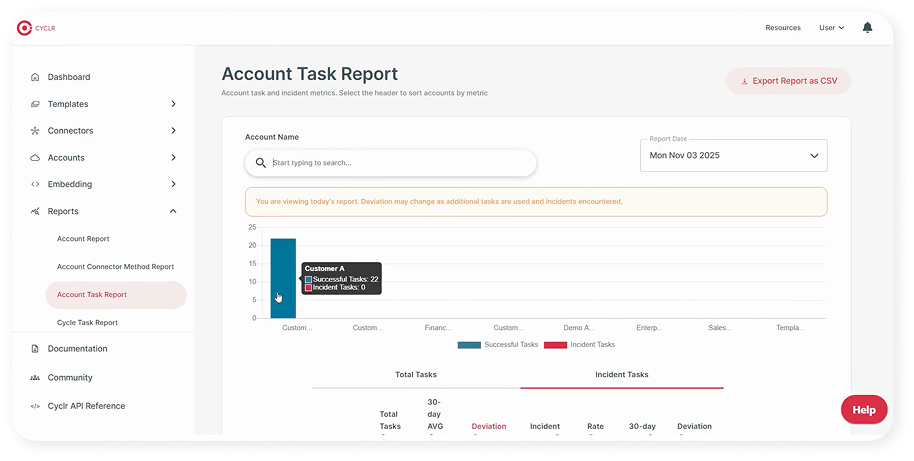
These capabilities are available in both our public cloud and private cloud models.
Cyclr, n8n and Embedding
When comparing the two platforms in terms of an embedded layer, Cyclr offers multiple options for SaaS companies to embed integrations directly within their applications. As a result, enabling end users to easily “turn on” or activate them.
The most convenient and out-of-the-box option is the Embedded Marketplace. With this feature, you can build an entire customer-facing integration experience without any programming or additional development effort. Additionally, the Embedded Marketplace allows full styling customisation. It can be embedded via an iFrame, ensuring it blends seamlessly with the look and feel of your own application.
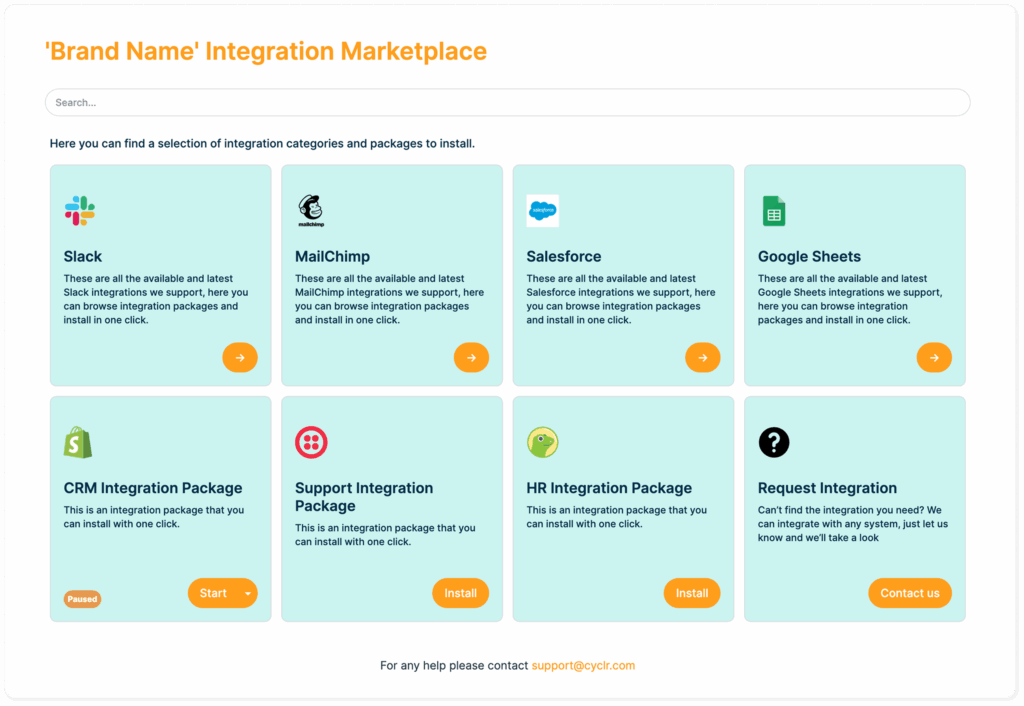
Imagine you’re running an AI SaaS platform where customers need to upload documents from various file storage systems. Example include Dropbox, Google Drive, or an SFTP server, and ingest that data into a vector database like Pinecone.
Within the Embedded Marketplace, you can implement marketplace categories and user-configurable data mapping fields. You can also include application authorisation processes, all directly inside your product.
For example, when an end user selects SFTP, they simply enter details such as the host URL, username, private key, passphrase, and time zone to complete authentication. Once the application is installed on the front end, the integration is automatically deployed. It will start running without any additional setup.
Behind the scenes, Cyclr’s multi-tenant architecture automatically provisions the pre-built integration template into the corresponding customer account. From there, the system extracts files from SFTP, processes them step by step, and seamlessly uploads the data into Pinecone.
n8n and Embedding
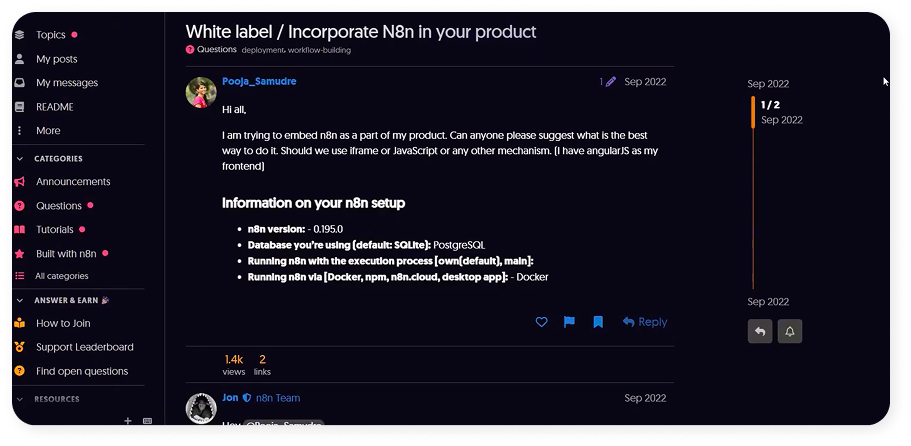
For n8n, embedding the platform within your product is only possible through its embedded model. This comes at a relatively high entry cost. Unlike Cyclr, there is no embedded marketplace available. The only alternative is to use the n8n REST API to design and build your own integration interface. A process that typically requires significant engineering resources.
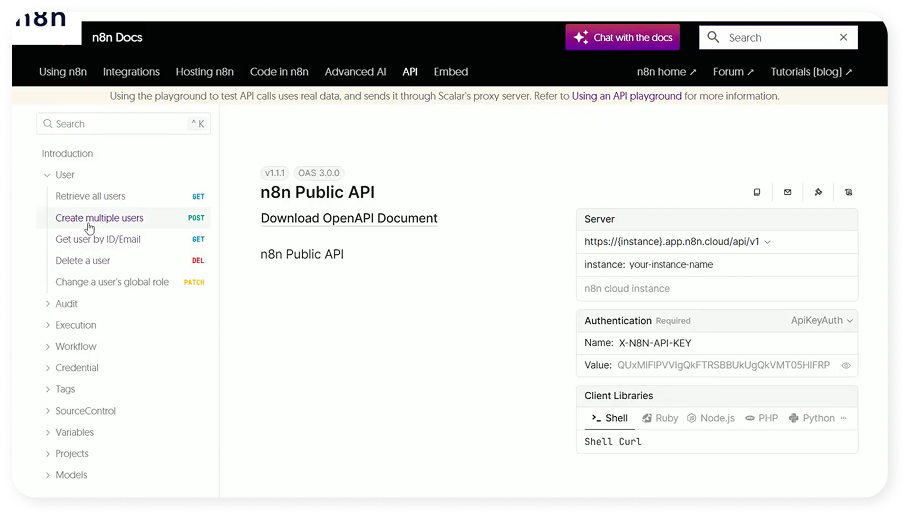
Additionally, this model can be deployed only within your private cloud and is not supported on n8n Cloud. As a result, creating a customer-facing integration experience in n8n tends to be complex. It cannot be achieved out of the box.
Who Is n8n Ideal For?
n8n is most suited to organizations with these characteristics:
- Technical maturity: You have development, operations, or integration teams capable of managing deployments, tuning performance, and debugging workflows. This is not intended for purely business users with zero engineering support.
- Need for flexibility and extensibility: If your integration requirements go beyond “move data 1:1 between SaaS apps,” and you expect to do transformations, custom logic, branching, occasional API hacks, then n8n shines.
- Desire for control: You want full visibility into workflow internals, custom logic, and the ability to debug and intervene. With n8n, you’re not locked behind proprietary connectors or black-box logic.
- Cost sensitivity and low vendor lock-in needs: Because n8n (especially self-hosted) avoids per-step or per-user pricing models (you often pay by execution), and is open/fair-code, it is more predictable at scale.
- Early or mid-stage integration scale: If you have dozens to low hundreds of automations, or a moderate number of event volumes, n8n can be your unified platform.
However, it is not ideal when your organisation demands a fully white-labeled embedded integration experience. Or when you don’t want your engineering team to bear the burden of building a “platform” around it.
When It’s Time to Move from n8n to Cyclr (or a More Embedded iPaaS)
At some point, n8n’s flexibility may become its liability. Especially in a SaaS company wanting to provide integration features to end users as part of your product. There are some “warning signs” and decision criteria for when considering migrating to a more embeddable, scalable platform like Cyclr.
1. You want a polished embedded experience
If your product roadmap includes offering integrations to your customers, such as “connect your CRM to our product” inside your UI, with branding, connector safeguards, tenant isolation, provisioning, and analytics. These will start to stretch n8n’s native capabilities. Cyclr and other embedded iPaaS solutions are built to package integration logic as a product feature. This means built-in embedding, UI, tenant management, and isolation.
2. You’re seeing growing scale, complexity, and fragility
As your number of workflows, data volume, and concurrency increase, and things begin dying or lagging unpredictably, the cost of maintaining a brittle n8n infrastructure begins to outweigh its flexibility. If your engineers spend more time firefighting integration failures rather than building features, that’s a sign it’s time to offload.
3. Governance, security, and SLA requirements exceed what n8n comfortably offers
In large enterprises or highly regulated industries, you may need stricter controls. Especially, around audit trails, access controls, streak sealing, usage quotas per tenant, and SLA guarantees. Embedded iPaaS platforms tend to provide deeper built-in governance, monitoring, analytics, and support layers.
Book a demo
Like what you’re reading so far and fancy seeing Cyclr in action yourself? Our integration experts can take you through the platform and answer your questions.
4. You’re hitting licensing or architectural limits
If your license begins to require paying for extra workflows, or you hit negotiated caps. As well as the architecture becomes untenable to expand, those are triggers to consider switching. Also, when your engineering team finds that they’re building an entire orchestration layer around n8n to patch its deficiencies. You may be reinventing what an embedded iPaaS should already deliver.
5. You want to free your team from integration ops maintenance
When you decide your engineering team should focus on core product development rather than maintaining the plumbing. That is a great moment to hand over the integration layer to a platform designed for that purpose. Offloading connector maintenance, versioning, deprecation handling, monitoring, and embedding to a specialist vendor can free up your development bandwidth.
Cyclr vs. n8n YouTube Series
We’ve dove into this Cyclr and n8n comparison and also made a series of YouTube videos on the subject. The videos and full playlist are available to watch now.
Conclusion: n8n as a Strategic Tool, Not a Forever Home
n8n is a compelling, flexible platform that can play a central role in enterprise automation and orchestration. Especially when you want control, extensibility, and an escape from rigid “no-code” constraints. It is particularly powerful for organizations with technical resources and mid-level automation scale.
But it is not without trade-offs. At scale, the operational burden, performance limits, governance gaps, and embedding deficiencies become material. For SaaS product teams seeking to offer integration features to their customers, a transition toward Cyclr or another embedded iPaaS can be the natural evolution.
Use n8n to get going fast, validate your integration patterns, and build your internal automation backbone. When the scale and ambitions demand it, graduate to a platform purpose-built for embedded, scalable, multi-tenant integrations.