Updated: | Originally published: | By Fraser Davidson
AI is reshaping how software companies think about automation, user experience, and interoperability. For B2B SaaS leaders, that shift raises an important question:
Will AI replace integration platforms?
In some areas, AI can absolutely improve how integrations are accessed, extended, and used. But when it comes to running the core workflows that move data between business systems, the answer is much clearer:
Not if reliability, compliance, and accuracy matter.
For embedded iPaaS buyers and SaaS product teams, the real opportunity is not to swap deterministic integrations for AI. It is to build an interoperability strategy that combines predictable execution with AI-powered flexibility.
Core integrations require certainty, not interpretation
Most business-critical integrations are not designed to be creative. They are designed to be dependable.
If a workflow handles:
- financial reconciliation
- quote-to-cash processes
- order fulfilment
- customer provisioning
- compliance actions
- support or CRM data synchronisation
then the expectation is not that it works most of the time. The expectation is that it works every time, in the same way, with a clear audit trail and reliable exception handling.
That is the standard enterprise software is held to.
Because in practice, “almost right” is still wrong.
No finance leader wants to hear that reconciliation was 97% accurate.
No revenue leader is reassured by 96% of orders being processed properly.
No executive team will accept 92% completion on GDPR deletion requests.
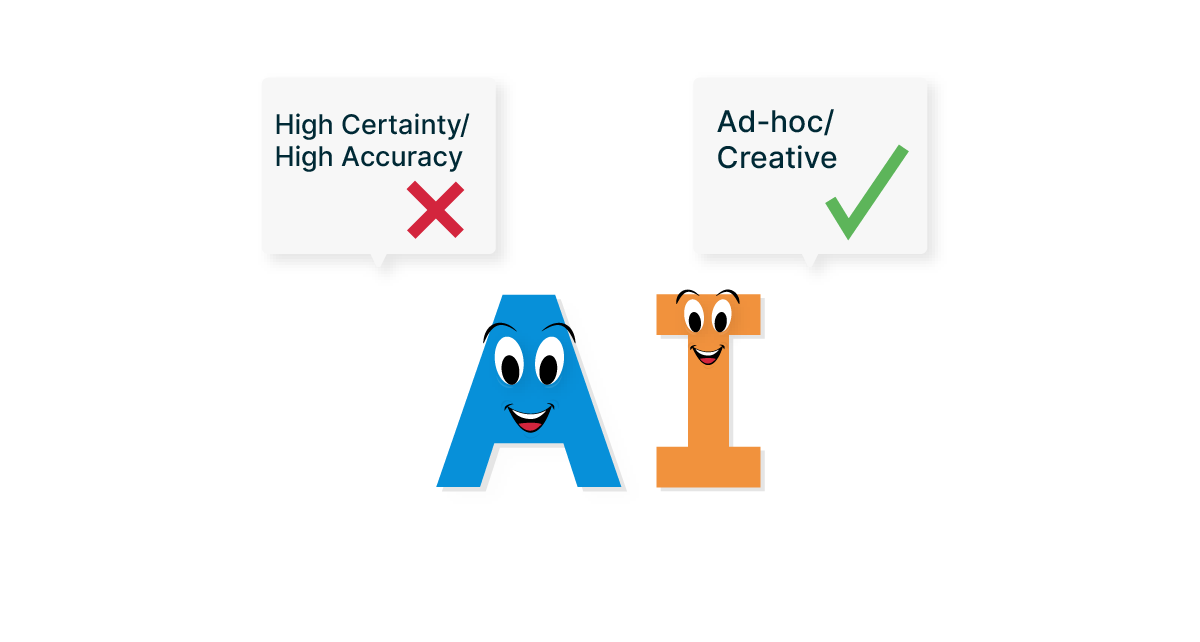
When workflows support core operations, AI’s probabilistic nature becomes a risk rather than an advantage.
Why AI is the wrong execution model for predictable workflows
Large language models are excellent at producing likely answers based on context. That is what makes them useful for summarisation, natural language interaction, recommendation, and reasoning across ambiguous requests.
But that same strength is also their limitation in operational workflows.
LLMs are predictive systems. They generate outputs based on probabilities, not fixed logic. That means two runs of a similar task may not behave in exactly the same way. Even when the variation is small, that uncertainty matters when data must be processed consistently.
Core integrations typically need deterministic behaviour such as:
- mapping fields in a defined structure
- sending payloads to the correct endpoint
- applying rules in a fixed order
- retrying known failures in known ways
- logging events for governance and support
- triggering alerts when something falls outside policy
That is not a judgment problem. It is an execution problem.
And execution is where deterministic software still wins.
Deterministic workflows remain essential for embedded iPaaS
For SaaS vendors embedding integrations into their products, this matters even more.
Customers are not just evaluating whether your integration capabilities are broad. They are evaluating whether they are reliable enough to trust inside production environments.
That trust depends on more than connectors. It depends on infrastructure that can consistently support:
- repeatable API-to-API execution
- multi-tenant delivery
- secure isolation between customer environments
- observability and alerting
- governance and compliance requirements
- scalable operations across many accounts
This is why deterministic workflows remain fundamental to embedded iPaaS.
They provide the predictable layer that product teams need if they want to ship integrations that customers can rely on without introducing avoidable operational risk.

AI can also become expensive when used in the wrong place
There is another challenge that often gets overlooked in AI strategy conversations: cost efficiency.
Every AI-driven action involves model usage. Every model interaction incurs token consumption. And token consumption adds cost.
That may be perfectly reasonable for high-value, low-frequency requests. But it becomes a very different proposition when applied to repeatable automation at scale.
If a workflow executes continuously across customers, environments, and applications, then using AI as the execution layer can mean paying more for a less predictable result.
For SaaS businesses, especially those monetising integration features or protecting product margins, this matters.
Deterministic workflows are often better suited to these use cases because they are:
- more economical at scale
- easier to govern
- easier to debug
- easier to support operationally
- better aligned to enterprise uptime expectations
In short, AI can add a lot of value. But for standardised integration execution, it can also add unnecessary cost.

Where AI does belong in integration architecture
This is not an argument against AI in interoperability. It is an argument for using AI where it is strongest.
AI becomes genuinely valuable when requests are:
- ad hoc
- ambiguous
- difficult to predefine
- dependent on context or intent
- exploratory rather than transactional
That includes use cases such as:
- querying connected systems in natural language
- generating reports across multiple data sources
- summarising account, support, or product information
- interpreting unstructured inputs
- validating information against defined business policies
- enabling one-off customer or internal requests without building a dedicated workflow first
This is where AI orchestration and technologies like MCP become powerful.
They allow users to interact with systems more flexibly, while giving SaaS vendors new ways to expose capabilities beyond rigid workflow design. In these scenarios, AI is not replacing integration infrastructure. It is sitting on top of it, extending what users can do.
The real future is not AI or integrations. It is both.
For SaaS leaders, the wrong framing is to ask whether AI will replace integration platforms.
The better question is:
How should AI and deterministic workflows work together?
The answer is a layered architecture.
Deterministic workflows for repeatable execution
Use deterministic integrations wherever the process is standardised, business-critical, and expected to run consistently at scale.
AI-powered orchestration for flexible interaction
Use AI where users need to explore, ask, interpret, analyse, or act on requests that are too variable to justify hard-coded workflow logic.
This combination is what modern interoperability increasingly looks like.
Not either/or.
And.
What embedded iPaaS buyers should prioritise
If you are evaluating an embedded integration platform, AI features may be compelling, but they should not distract from the fundamentals.
You still need a platform that can deliver:
- dependable workflow execution
- reusable and manageable connectors
- tenant-aware architecture
- enterprise-grade security and compliance
- visibility into failures, retries, and exceptions
- a scalable model for supporting many customers
Once that foundation is in place, AI becomes far more useful.
It can enhance the customer experience through:
- conversational access to integration actions
- AI-assisted workflow design
- dynamic reporting and summarisation
- MCP-based interfaces to product capabilities
- ad hoc requests that sit outside standard automations
The strongest products will not force customers to choose between structure and flexibility. They will offer both.
A simple rule for deciding when to use AI in integrations
A practical framework is this:
If the task is repeatable, rules-based, and accuracy-sensitive, use a deterministic workflow.
If the task is dynamic, unclear, or shaped by user intent, AI may be the right interface.
And when an AI-driven task becomes frequent and predictable, that is often a signal it should be converted into a structured workflow.
This is the shift SaaS teams should focus on: using AI to improve access and adaptability, while keeping deterministic systems responsible for dependable execution.
Conclusion
AI will change integration strategy. But it will not eliminate the need for integration infrastructure.
For embedded iPaaS buyers and SaaS leaders, deterministic workflows remain essential wherever uptime, data accuracy, compliance, and trust are non-negotiable. At the same time, AI opens up new possibilities for ad hoc orchestration, discovery, and user interaction.
The opportunity is not to replace one with the other.
It is to combine both in a way that gives customers reliable execution when they need certainty, and intelligent flexibility when they need speed, context, and adaptability.
That is the real shape of modern integration architecture.