
Updated: | Originally published: | By Fraser Davidson
Yes — AI platforms and embedded iPaaS can work extremely well together when each system plays to its strengths. AI adds speed, adaptability, and intelligence, while embedded iPaaS adds control, security, governance, and embedded interoperability.
In simple terms:
- AI helps decide, generate, and enrich
- Embedded iPaaS helps connect, orchestrate, and secure
- Together, they let SaaS teams deliver smarter product experiences without losing control of customer data or authentication flows
This is why the combination can be so effective: AI brings innovation, while embedded iPaaS provides the operational structure needed to use that innovation safely at scale.
Many of us are learning and understanding how the applications can be used. From everyday life, a creative asset or a helpful business tool. As well as how these platforms can be regulated to ensure data, creativity and job protection.
Why AI platforms and embedded iPaaS work well together
AI platforms are good at generating content, interpreting inputs, summarising information, and making recommendations. But they are not designed to be the system of record for secure connectivity, credential handling, or governed data movement.
Embedded iPaaS solves that problem. It gives SaaS companies a controlled integration layer for moving data between applications, managing authentication, and enforcing security rules.
That makes the partnership useful because:
- AI improves decision-making and automation
- Embedded iPaaS manages secure integration delivery
- Embedded interoperability ensures systems can exchange data in a structured, reusable, and scalable way
- Customers get smarter workflows without giving up control
Discover Cyclr’s Embedded iPaaS
As AI becomes central to modern SaaS, the real differentiator won’t be the model, it will be the infrastructure that connects it to the rest of your ecosystem.
Cyclr’s embedded iPaaS gives you the tools to securely orchestrate data, manage integrations at scale, and empower AI features with the context they need to deliver real value.
Example: using embedded iPaaS to power AI safely
Imagine a SaaS platform that helps customer success teams manage accounts.
A product team wants to use AI to:
- summarise support tickets
- detect churn risk
- recommend next-best actions
To do that well, the AI needs access to data from systems like a CRM, helpdesk, billing platform, and product analytics tool.
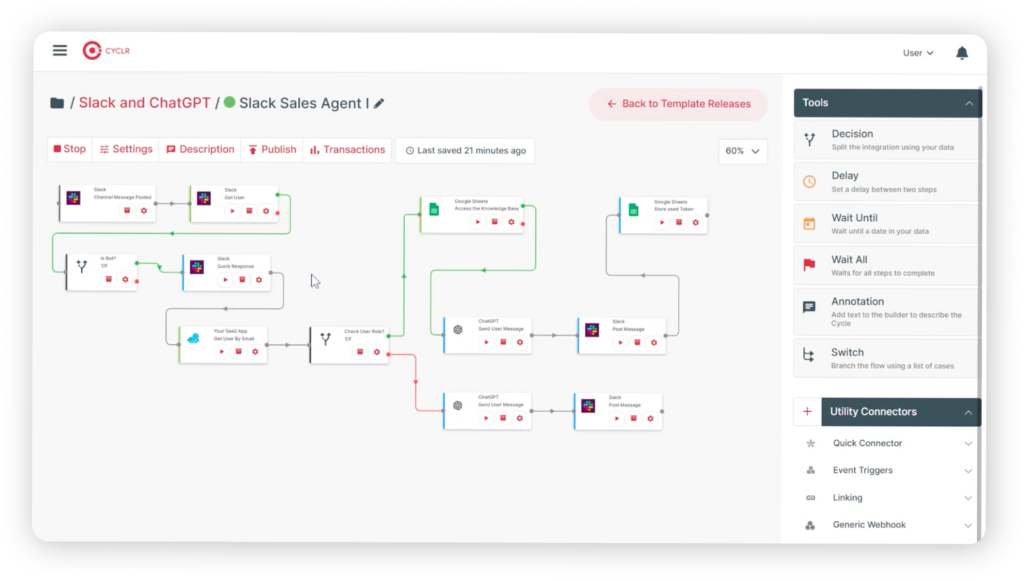
This is where embedded iPaaS helps. Instead of giving the AI platform direct access to every system and every credential, the embedded iPaaS handles the integrations, authentication, and governed data flows. The AI receives only the data it needs, in the format it needs, with the right controls in place.
The result:
- better AI outputs
- stronger security
- clearer auditability
- faster deployment of customer-facing AI features
Partnership vs. AI built directly into embedded iPaaS
There is an important distinction between:
- using AI alongside embedded iPaaS, and
- building AI directly into an embedded iPaaS product
Using the two in partnership is often the lower-risk model. Embedded iPaaS can manage data access, integration logic, and security boundaries, while the AI platform handles tasks like reasoning, generation, or summarisation.
Building AI directly into an embedded iPaaS product can be more complex because vendors must be very clear about:
- where customer data is sent
- how prompts are processed
- what third-party models are involved
- how privacy, compliance, and retention are handled
That is why many vendors are comfortable enabling AI through orchestrated external workflows before embedding it deeply into the platform itself.
Conclusion
AI platforms and embedded iPaaS are at their best when each does what it was built to do. AI can drive insight, automation, and innovation, while embedded iPaaS delivers the security, structure, and embedded interoperability that make those outcomes reliable in the real world. For SaaS vendors, that balance is where the real value lies: smarter product experiences, better-controlled data flows, and a more trustworthy foundation for scaling AI.
Share your thoughts and keep the discussion going with Fraser on LinkedIn!